
Cite as:
Bar-Yam, Y. (2025). Oscillatory Spacetime as the Physical Origin of Spinors, Wavefunctions, and Quantum Measurement. Zenodo. https://doi.org/10.5281/zenodo.17981536, NECSI Technical Report 2025-12-01
Overview
Wave–particle duality is the defining mystery of quantum mechanics. Particles appear point-like in localized interactions, yet interference and diffraction require a wave description encoded in the wavefunction and its dynamics. The formalism is extraordinarily successful, but it leaves unresolved the physical nature of the wavefunction, the origin of probability, the role of measurement, and the status of several key assumptions built into the theory.
What happens if we revisit the particle itself?
It turns out that replacing the structureless point particle with a localized internal rotational motion, analogous to a clock or gyroscope, immediately gives physical meaning to the wavefunction. The wavefunction no longer represents an abstract probability, but instead encodes the persistent internal dynamics of the particle as it moves and interacts.
Remarkably, this single change removes the need to postulate many central features of quantum mechanics. Probabilities arise from internal dynamics and interaction, spin follows geometrically, and the Dirac equation emerges as the minimal dynamical law consistent with the internal rotation. Measurement outcomes are consistent with standard quantum mechanics because the wavefunction already encodes the observable effects of that internal motion. Quantum rules then govern how those effects appear in interaction.
Perhaps most surprisingly, the internal rotational motion becomes the origin of quantum dynamics precisely because it is persistent and is represented across space and time by the wavefunction.
The basic concepts and the link between particle and wavefunction are accessible to readers familiar with quantum mechanics and open up a range of important problems—extensions, limits, and generalizations—providing a concrete framework for new directions where new directions and insights where progress has been difficult before.
Technical Synopsis
This paper develops a geometric and dynamical framework in which elementary quantum excitations arise from localized singularities of spacetime with an internal oscillatory degree of freedom. Spinorial structure, Weyl–Dirac dynamics, superposition, and measurement emerge from the geometry of this oscillation and its transport through spacetime, rather than being introduced as postulates. The work builds on and extends earlier ZM theory, offering a unified physical interpretation of spin, interference, and measurement.
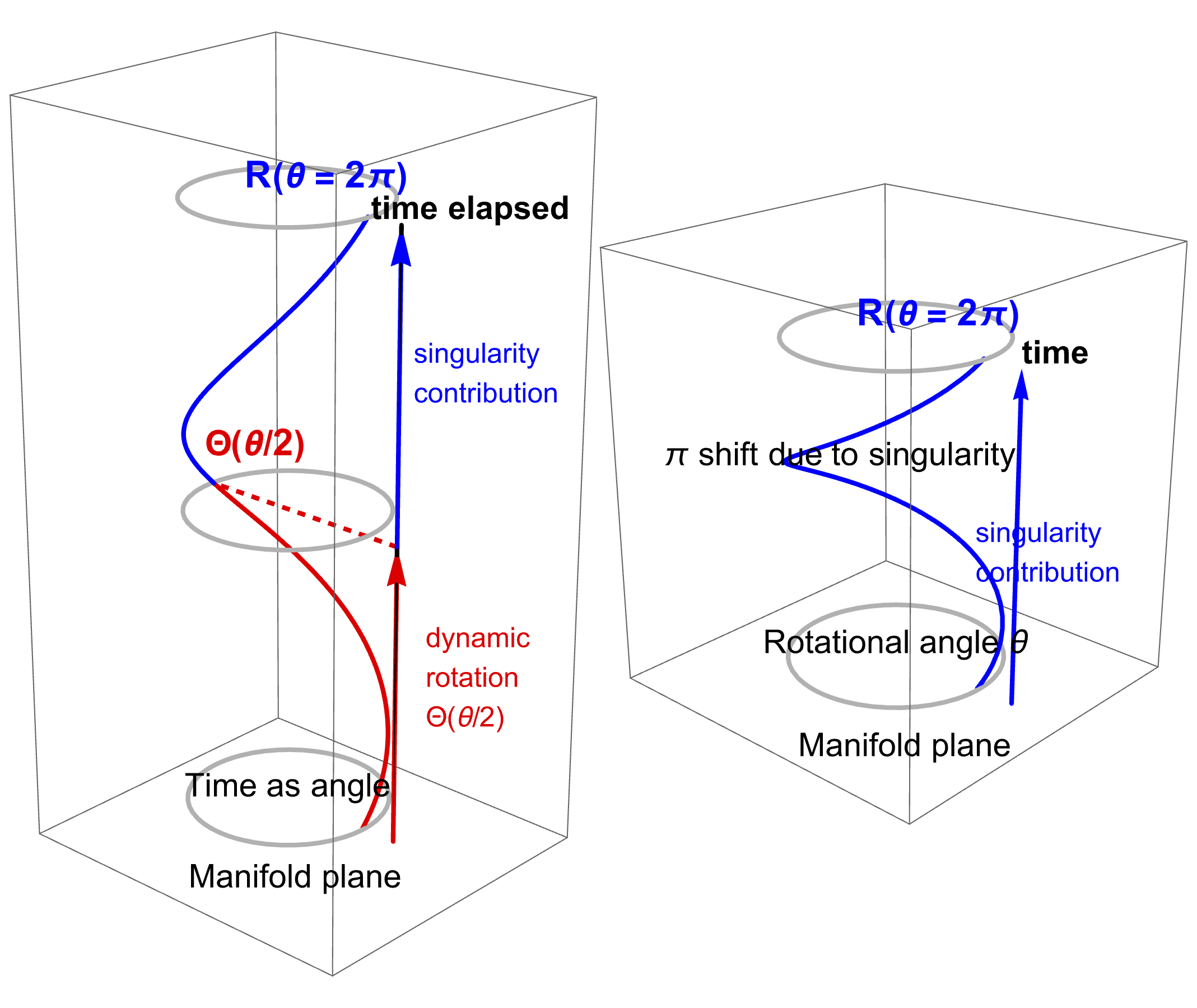
Fig 1. Rotational motion arising from a spacetime singularity.
Right: Near the singularity, the physical time coordinate traces a helical path as the defect is encircled, reflecting the multi-valued structure.
Left: The total elapsed time during a spatial rotation combines this helical behavior with the intrinsic time evolution of the singularity itself. Together, these describe how rotational motion and time evolution are unified in the same geometric structure.