A simple shift in assumptions with wide consequences
Quantum mechanics is the theory that describes how the smallest particles in nature move and interact, and how—together—they build the world around us. For more than a century, it has worked extraordinarily well. But it has also been deeply puzzling.
Traditionally, quantum mechanics treats particles as tiny points in space. To explain their strange behavior, physicists also introduce a wave—a mathematical object that spreads out like a ripple on water and tells us the probabilities of what we might observe. The particle acts like a point when we measure it, but like a wave when it moves. This wave–particle duality has always seemed paradoxical, even though physicists have learned how to calculate with it very successfully.
A new idea suggests a different way to look at this picture. What if the particle itself is not just a point?
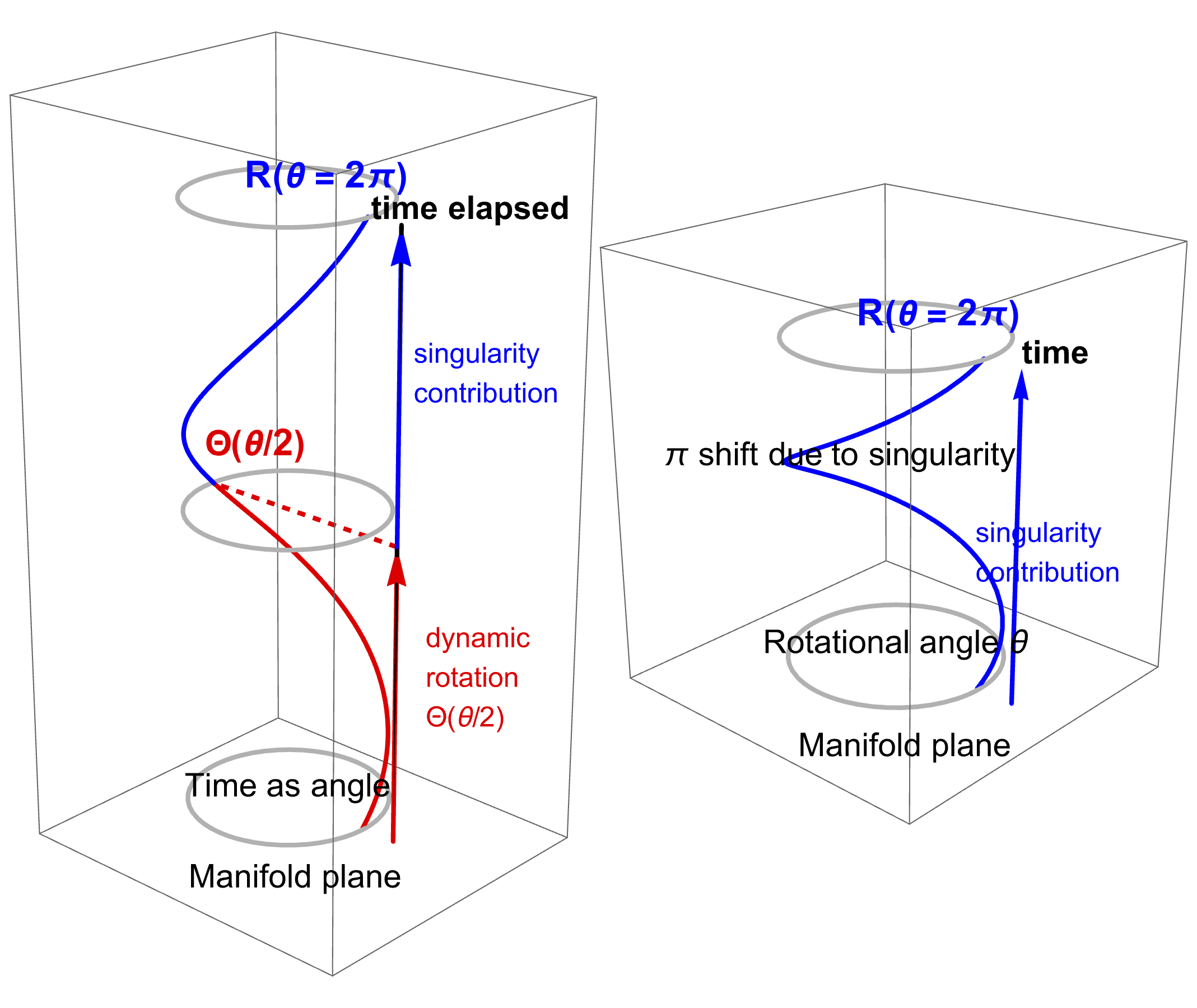
Instead of a structureless dot, imagine that each particle has a tiny internal rotation, something like a clock or gyroscope. This internal motion is extremely fast and persistent, so the particle can move through space without losing its identity. The particle is still localized—it still hits detectors like a point—but it carries an internal rhythm with it wherever it goes.
In this view, the wave is no longer a mysterious extra object added on top of the particle. The wave is simply a way of keeping track of the particle’s internal motion as it moves and interacts. Features like probability, interference, and spin arise naturally from how this internal “clock” lines up, evolves, and is disturbed when the particle interacts with its surroundings.
Surprisingly, starting from this simple idea—replacing a point particle with a particle that has internal rotation—leads directly to the central mathematical structure of quantum mechanics, including the famous Dirac equation, without adding extra assumptions by hand.
By putting structure inside the particle instead of outside it, this approach removes much of the mystery surrounding wave–particle duality. It offers a clearer physical picture of what the wave represents and why quantum mechanics has the structure it does, while opening new directions for understanding the smallest building blocks of nature and how they give rise to the world we experience.